
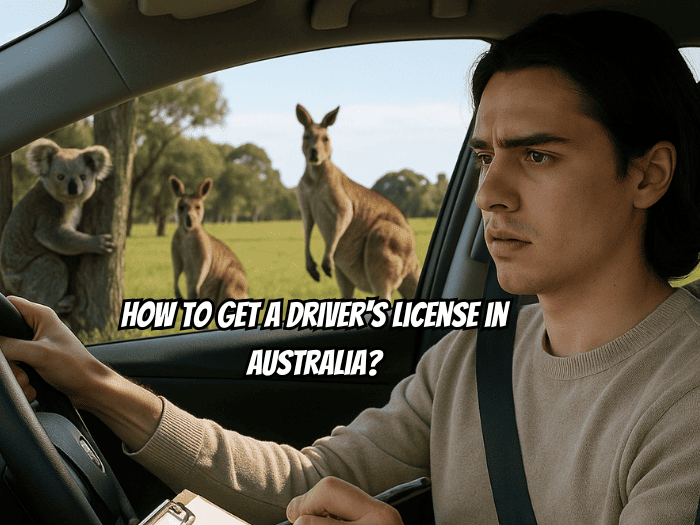
Obtaining a driver’s licence in Australia is an essential step if you plan to live, work, or study in the country. While every Australian state has its own licensing rules, the overall process follows a similar pattern that includes theory tests, practical exams, supervised driving hours, and residency requirements.
Below you’ll find a complete guide explaining everything you need to drive legally in Australia.
🚗 Types of Driver’s Licences in Australia
In Australia, driver’s licences are divided into categories and stages. Each state (New South Wales, Victoria, Queensland, South Australia, Western Australia, etc.) manages its own system, but the most common stages are:
Learner Licence (L Plate)
A learner’s permit that allows you to start practicing under supervision.
Provisional Licence (P1 and P2)
A provisional licence with certain restrictions such as lower speed limits and zero blood alcohol concentration.
Full Licence
An unrestricted licence that allows you to drive freely with no additional conditions.
If you’re new to the country, you can drive with your valid foreign licence for a limited time (usually 3 months). After that period, you must apply for an Australian licence.
📋 Requirements to Obtain a Driver’s Licence in Australia
Although requirements vary slightly by state, the most common ones include:
- Minimum age: 16 years old for a Learner Licence (L)
- Identity document: valid passport or visa
- Proof of address: utility bill or rental contract
- Medical exam: required in some cases
- Theory test: covers traffic rules, signs, and safety
- Practical test: on-road driving exam with an instructor
💡 Step-by-Step: How to Apply for Your Licence
1. Get Your Learner Licence (L)
- Complete the theory test (online or in person)
- Provide identification and proof of address
- If you pass, you will receive your L plate
- You may only drive with a fully licensed supervisor
2. Move to a Provisional Licence (P1 / P2)
- Complete a logbook with at least 100 hours of supervised driving (including 10 hours at night)
- Take the practical driving test
- Receive your P plates (red for P1, green for P2)
- Follow restrictions such as speed limits and zero alcohol tolerance
3. Obtain Your Full Licence
After 2 to 4 years of driving experience (depending on each state’s rules), you can apply for the full unrestricted licence.
🌍 Driving With a Foreign Licence
If you arrive in Australia with a driver’s licence from your home country, the rules depend on where it was issued:
Recognized Countries
Spain, Chile, Italy, and other approved nations allow you to transfer your licence without taking the practical test.
(Some states still require you to take the theory test.)
Other Countries
You must take both the theory and practical exams.
In all cases, you must provide either:
- an official NAATI English translation, or
- an International Driving Permit (IDP)
💰 Approximate Costs (2025)
| Process | Average Cost (AUD) |
|---|---|
| Theory test | 25 – 50 |
| Practical test | 60 – 120 |
| Learner Licence | 25 – 60 |
| Provisional Licence | 150 – 250 |
| Full Licence | 200 – 350 |
💡 Tip: In some states, you can pay lower fees if you choose a shorter licence period (e.g., a 1-year licence instead of 5 years).
🧠 Tips to Pass the Tests Quickly
- Practice with online Driver Knowledge Test (DKT) simulators
- Learn local speed limits and traffic signs
- If you’re a foreigner, bring your passport and printed visa
- Use your state’s official driver handbook/manual
📚 Official Driver Handbooks (Study Material)
These manuals contain all the theoretical content, rules, and diagrams required for you to pass the knowledge test.
Each state provides a downloadable pdf or online version.
📍 Where to Apply for Your Licence (State by State)
- New South Wales (NSW): Service NSW
- Victoria: VicRoads
- Queensland: Transport and Main Roads
- South Australia: Service SA
- Western Australia: WA Transport
🧭 Conclusion
Getting your driver’s licence in Australia is a straightforward but demanding process. With proper preparation, knowledge of local road rules, and consistent practice, you can obtain your licence without complications and enjoy the freedom of driving across the country.
Always remember something very important — and this can be difficult to get used to at first:
Both Australia and the United Kingdom drive on the left-hand side of the road, and vehicles have the steering wheel on the right-hand side.