


Octane rating is a measure of a fuel’s ability, such as gasoline, to resist detonation in a vehicle’s engine. This measurement quantifies the “knocking” or “pinging” phenomenon, which occurs when the air-fuel mixture ignites prematurely, before the spark plug can ignite. This uncontrolled detonation can cause long-term engine damage, so it’s critical to use a fuel with the correct octane rating for your vehicle’s engine.
How is octane measured?
Octane is measured using two main methods:
Research Method (RON):
This method is more common in Europe and South American countries, this method measures resistance to detonation at low engine speeds.
Research Method (AKI or PON):
This method simulates more severe conditions and is used primarily in the United States. It measures resistance to detonation at high temperatures and pressures.
On the other hand, the octane rating reported in countries such as the United States and Canada is usually a combination of both methods, known as average octane rating (AKI or PON), which is obtained by adding the RON and the MON and dividing the result by two.
What is the importance of octane?
Octane rating is crucial for engine performance, efficiency, and maintenance. An engine designed to run on high-octane gasoline can experience improved power and fuel efficiency. In contrast, using a fuel with a lower octane rating than recommended can result in premature detonation, loss of power, and increased fuel consumption.
The recommendation is always to use the octane rating of gasoline recommended by the manufacturer.
Myths about Octane
It’s a widely held belief that higher-octane gasoline is “purer” or “cleaner.” This is completely false. Higher octane gasoline has greater resistance to self-detonation, and this is critical to preventing damage to vehicles with engines designed to run on higher octane ratings due to their compression ratios. Therefore, the best gasoline for your vehicle is the one recommended by the manufacturer.
Compression ratio vs. Octane rating to use
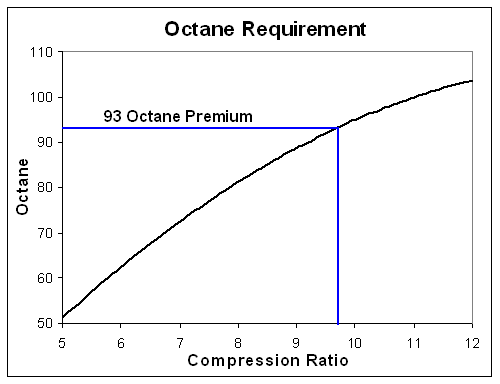
There is an important relationship between fuel octane and an engine’s compression ratio. As we mentioned earlier, octane is a measure of a fuel’s ability to resist premature detonation, which is the explosion of fuel in the cylinder before the spark plug ignites it. This premature detonation can cause engine knocking and long-term damage.
Compression ratio is the measure of how many times the air-fuel mixture in the cylinder is compressed before ignition. Higher compression ratios result in greater combustion efficiency and, generally, more power. However, as the compression ratio increases, the risk of premature detonation also increases.
Therefore, engines with a high compression ratio require higher octane fuels to prevent premature detonation. Using a lower octane fuel in an engine designed to run on a higher octane can result in loss of power, inefficient operation, and possible engine damage.
In summary, for high-compression engines, it is recommended to use fuels with a higher octane rating to ensure safe and efficient operation.
Conclusion
Gasoline octane rating is an essential characteristic that influences the performance of combustion engines. Choosing the right type of gasoline not only ensures optimal vehicle performance but also contributes to its durability and efficiency.
Related Video, How an Engine Works? (ENG-SUBS)
Bibliography for this article:
Repsol Petrol Company: https://www.repsol.es/particulares/asesoramiento-consumo/octanaje-octano
National Energy Commission of Chile: https://www.cne.cl/wp-content/uploads/2021/08/2021_07_15_MEPCO.pdf